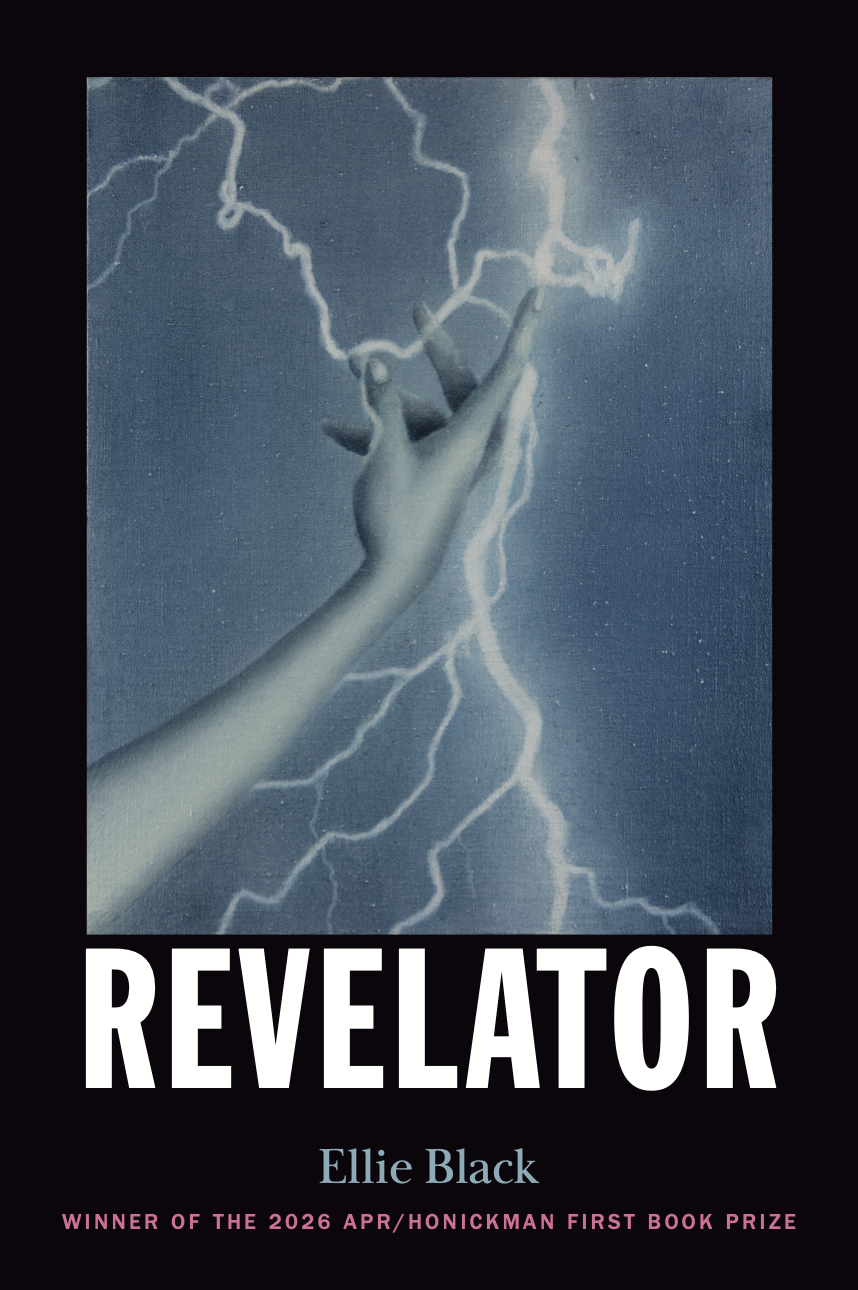
REVELATOR was selected by Dorothea Lasky as the winner of the 2026 APR/Honickman First Book Prize and published by the American Poetry Review through Copper Canyon Press in September 2026. Order from Bookshop, the American Poetry Review, The Poetry Shop, or from anywhere else books are sold. You can also preorder a signed copy from Square Books (they’ll ship after 9/14).
Ellie Black's debut collection, Revelator, glitches and falters, iterates and alludes. This is a book concerned deeply with what's real, what's fake, and what's fantasy. With equal parts humor and horror, this fragmented, oracular collection explores the consequences of the increasingly blurry digital-physical landscape in which we find ourselves and its relationship to power, control, and what we worship. These poems transform shards of language, pop culture, and literature into a tightly wound poetics of excess engaged with an incantatory attention to sound. Famous women, teenage girls, movie characters, and reluctant prophets are victims, villains, and victors, sometimes all at once. Here, boundaries blur between high and low. Angels visit and animatronics come to life. Sylvia Plath, Lee Edelman, and Evil Dead II share space in a single poem. Revelation, this collection proposes, exists at the limits of confessional poetry, religious confession, the dramatic twist, and the divine promise of an apocalyptic ending. Revelator offers up a mirror to how we invent and perform ourselves on stages, on screens, and in our lives.
From its hortatory and haunting opening poem "Be Not Afraid" to the final, eponymous lyric with its repeating riffs on the Blues and gospel song "John the Revelator," Ellie Black's debut collection Revelator is a collection both for our time and for the ages. Black writes poems that revel in poetry's polysemous, polymorphous possibilities while also embodying a poetics that can function as a site of critique and dissent in relation to our fraught contemporary moment. Drawing from all manner of sources—songs, scholarly texts, popular literature, film, and more—and the poet's original vision and immense skill, Revelator opens itself up to and rewards repeated readings—or as the title poem concludes, "The end I write is not an end in sight.”
—JOHN KEENE, author of PUNKS: NEW & SELECTED POEMS
PRAISE FOR REVELATOR
Ellie Black writes with the urgency of someone who knows the body and the internet are both battleground and altar. These poems crackle electric with nerve and intellect—a live wire between the sacred and the pixelated. Black's poems are unafraid to confront power, spectacle, and girlhood rendered mythic and monstrous. A most dazzling debut!
—AIMEE NEZHUKUMATATHIL, author of NIGHT OWL
"I till the land of myself. I land myself / the role of me," writes Ellie Black in a book that, with sly tautologies and fraught zingers, plays with what it means to play.
Black sets somber times to careening music, exploring gender and violence, 90s pop culture, and weaponry both figurative and literal; in the description of a gun that "glistens matte against papers / that explain its origin," Black invites us to read these poems as origin-explaining papers in their own right.
—NATALIE SHAPERO, author of STAY DEAD
Ellie Black's Revelator sharpens the lyric I and drives it through the skull of the confessional mode. But in the world of these poems' maniacal rhythms and perfectly calibrated jokes, a knife wound only allows all the sincerity to show. Via riddle and endless paradox, Black asks what it means, in our time, to be good, to be real, to be a human girl: YOU MUST BE DECORATIVE YOU MUST BE SUBSTANTIAL, an angel demands, while a game designer constructs a landscape of pixelated tears. When an interviewer asks Tonya Harding, What makes a girl? Tonya Harding answers, as though it's obvious: Visible light. Revelator is an expert's guide—and a gift—to the 21st century.
—MELISSA GINSBURG, author of DOLL APOLLO